Author: Sue-Ann Bubacz

  • Marconi vs Tesla: Who REALLY Invented Radio?

    Marconi vs Tesla: Who REALLY Invented Radio?

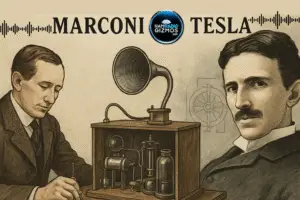
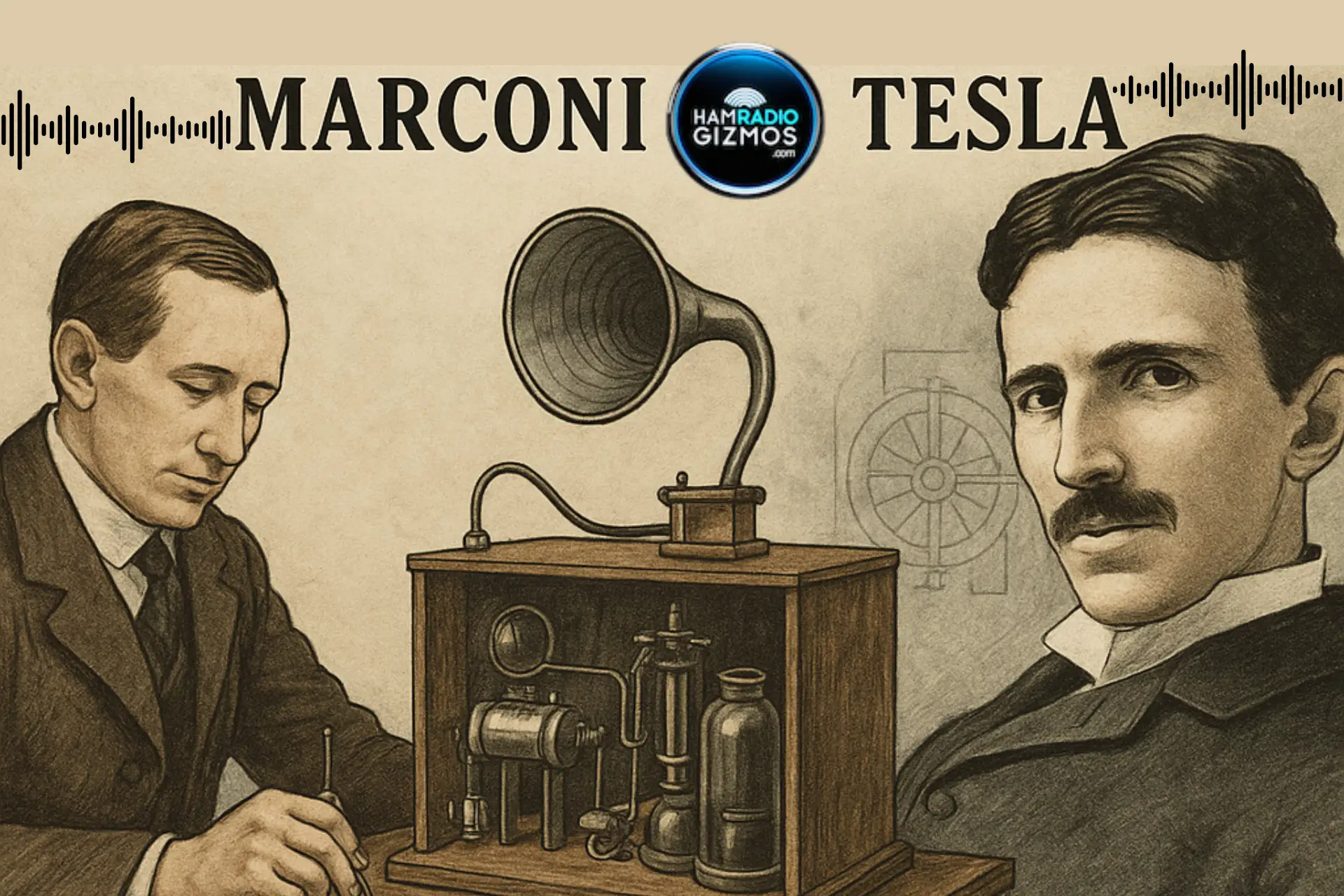
    Who REALLY Invented Radio? Title Visual for Ham Radio Gizmos post.

    A mad scientist and a savvy businessman walk into a bar… haha, just kidding, but this line is a great opening for the Tesla vs. Marconi saga in the quest for wireless radio wave transmission. 

    So, who really was the inventor of radio, and who owns the patent? That’s exactly what we set out to learn in Ham Radio Gizmo’s video to uncover the story and grab some answers for you about the discovery of radio, who it’s attributed to, and why.

    Thanks to our super-fab viewers, we learned that there continues to be speculation about the true origins of radio technology and its earliest innovators. 

    Still, the Tesla vs. Marconi tale is an interesting one to tell to help us understand the history of radio. Plus, it gives a glimpse of how things transpired in our revolutionary past, especially around innovation, new technology, business models, and intellectual property. It’s quite enlightening. 

    Besides, radio technology did lead to a whole bunch of fun discoveries for many, many years for Ham Radio lovers the world over! But, back to the feud at hand…

    Marconi vs. Tesla: Patents Filed

    You may find it surprising to hear that Tesla was the first to file a patent; however, Marconi held it— and made a bucket ton of money off it nonetheless— for a long time.  

    Let’s rewind to the late 1800s. Electric lights were wild enough, but TESLA, the showman genius, was dreaming bigger: WIRELESS energy and communication were dancing in his head. In 1891, Tesla invented the Tesla coil—glorious electric arcs for his demos, yes— but crucial for generating radio waves and experimenting with wireless energy. It’s still used in radio tech today!

    By 1893, Nikola Tesla publicly displayed his wireless signal transmission with tuned resonant circuits, matching frequencies, and transmitting info without wires. He even sketched out the blueprint for GLOBAL wireless. Wow, right?

    Beyond these lectures and demos in St. Louis, Tesla by 1897 had filed radio transmission (US) patents detailing:

      • Transmission of electrical energy wirelessly
      • Concept of matching transmitter and receiver frequencies

    Initially, the U.S. Patent Office rejected many of Marconi’s U.S. filings, pointing to Tesla’s 645,576/649,621 as prior art, even calling Tesla’s “oscillator” a household name.  Despite this, in a surprising 1904 reversal, the USPTO granted Marconi a radio patent in the U.S. Tesla was dismayed by this, and quipped to an associate, “Marconi is a good fellow…he is using seventeen of my patents.

    But sometimes (as you know) it’s not what you know but who you know. So, despite the earlier filings of Tesla, but also by names like Lodge and Stone, Marconi prevailed. At least for the entirety of Tesla’s life.

    Backed by the British aristocracy and powerful and influential individuals like Edison and Carnegie, Marconi had helpers. However, J.P. Morgan pulled Tesla’s much-needed funding, making things even more dire for Tesla and his genius work.

    The Battle Between Nikola Tesla & Guglielmo Marconi Fizzles

    Meanwhile, the accolades and rapid adoption of Marconi’s wireless system in maritime, military, and communication networks led to a Nobel Prize win in 1909.

    Tesla sued Marconi’s company in 1915 for infringement, but lacked the resources to continue, so nothing was resolved.

    Finally, after Tesla died in 1943, the U.S. Supreme Court faced Marconi Wireless Corp. vs. USA (for wartime royalties). The Court ultimately invalidated Marconi’s broad tuning patent claims as already anticipated by earlier inventors (John Stone, Lodge, and Tesla). Tesla’s patents were reinstated, technically naming him the inventor of radio.

    Despite a lack of recognition and money at his death, Tesla and his role in radio are celebrated in recent decades with Tesla Day Remembrance. However, most historians credit Marconi with radio’s practical implementation. The controversy reminds me of the “chicken and egg syndrome,” in a way.

    But perhaps the lesson is more. The contrast in approach with Tesla’s grand, visionary ideas, often unrealized, and Marconi’s focus on practical, commercial development may have been the perfect spark for a dream team for radio innovation and tech, with powerful business clout wired in!

    Instead, it feels a little more like winners and losers. Maybe it’s a great reminder that everyone has something to contribute. And, you know, the sum of the whole is greater than its parts… something like that…

    Further Contributors to the Radio Wave

    Heinrich Hertz gave the concept its experimental life in the 1880s. Oliver Lodge and Édouard Branly enabled detectors (coherers) to convert waves to signals. Reginald Fessenden (Canada/US) later pioneered voice broadcasting (1906), and Lee de Forest invented the triode tube (1906) to amplify radio – all of these building on the Tesla/Marconi groundwork.

    Hertz, Lodge, and Stone may have contributions preceding or aligning with those of the rival two. But again, more heads, even radio heads, allow for a bigger combined result. All were integral to the revolutionary changes of the times, and we still benefit from them today.

    More From the Ham Radio Gizmos Blog:

  • Wings to Waves: Heathkit’s Surprising Origins to a Ham Radio Revolution

    Wings to Waves: Heathkit’s Surprising Origins to a Ham Radio Revolution

    Wings to Waves Heathkit’s Surprising Origins to a Ham Radio Revolution

    The remarkable legacy of the Heath Company and its famous Heathkit DIY electronics ‘kits’ revolutionized how people learned about electronics by offering clear instructions and hands-on projects that made it fun, accessible, and educational.

    As a surprise to many Heathkit-loving Ham Radio builders, the first kits were for building Airplanes! And yes, I mean full-size flying machines, at least until a Heath Company founder (literally) crashed on a new plane’s test run in 1931. 

    But, thanks to surplus WWII electronics the company bought up, and a scramble over the railroad boxcars overflowing with parts, the company pivoted into “make-your-own” kits, sparking a long-lasting love of DIY electronics, Ham Radio, and geek inventions of all kinds! 

    The nostalgia and love of Heathkits are apparent in the multiple and extensive stories and heartfelt memories of learning and building these kits at school, with a dad, grandad, or uncle, the Boy Scouts, or for a family’s first TV in the home. And it expands into igniting electrical engineering careers, sparking new inventions, and leading to future innovation. 

    Heath’s apparent love for the “gadget” over money was reflected in a company culture where engineers were more important than “bean counters,” and education was at the forefront. Touted for the precision and instructional care of their kit-building directions, their reputation for educating their customers is still well-respected today. 

    Not only did you build something that works (many still in operation), but you also learned something along the way. Opening your kit was a moment of excitement! But the sheer genius of the instructional manuals, with perfect illustrations and explanations for each step, fondly remains a core element of Heathkit’s perpetual customer affinity. 

    Hands-on Education as a Differentiator

    For a company selling products— namely, parts kits to build electronic devices— their legendary instruction manuals turned every kit into a mini electronics course. The manuals’ influence on education for learn-by-doing set an admirable educational standard and became a demonstrable differentiator for the business. 

    This kind of impact makes the fond and nostalgic memories of Heathkits a universal shared language for many folks in Ham Radio, along with scores of others. Curiosity, learning, and adventure were all found inside your Heathkit on its arrival. 

    The Power of the Heathkit Community

    A community powered by curiosity and inventiveness, even as the market shifted and technology advanced, captured the spirit and pride in saying, “I did it myself,” and inspires craftsmanship and innovations to this day. 

    The Heath Company’s long run and engaged community of builders in schools, groups, basements, and garages every which where, is part of a shared cultural experience and a roaring and growing time in our history. A fun time. A creative and imaginative time. 

    Young people today building projects with Arduino Boards or Raspberry Pi computers share the same spirit, as the “makers market” continues to shine in Heathkit fashion. 

    Heath’s remarkable company journey shows us that innovation is born when we:

    • embrace chaos,
    • educate our audience, and 
    • invite people to be part of the creation. 

    And sometimes, the best innovations come from unexpected setbacks. 

    Check out the full episode, What Happened to Heathkit? The Ham Radio Legend That Vanished!” for more history, laughs, and lessons, and go ahead and subscribe for more from the Ham Radio Gizmos channel while you’re there! Thank you so much.

    More on the Video:

    What People Are Saying About the Heathkit Story

    Thank you for all the kind comments, beautiful memories, and sweet sentiments shared by viewers of this story on the Ham Radio Gizmos YouTube Channel! 

    It’s difficult to pick out particular shares to showcase because we greatly appreciate each comment.

    But here are a few that stole our hearts, and we thought you may enjoy them too! 

    @ScottGrammer

    “I built many Heathkits as a kid. When I built my first one, I was ten. It was a digital clock kit my dad had bought to build himself, and I talked him into letting me build it. He taught me how to solder (much to my mom’s chagrin), and we were both shocked when it worked the first time we plugged it in. Thanks, Dad. I miss you.”

    @rohnkd4hct260

    “Heath was great. I drooled over the catalogs many days. I was a poor Jr high student with no income, so all I could do was wish.  Today, after two degrees in electronics and 30+ years as a ham, I now own some of those Heathkits I wanted so bad.  Long live HEATHKIT!!!!!!!”

    @ripjones5294

    “Hello, I’m Rip Jones, and I’m a Heathkit Nerd. Not only did I build, but I still have every Heathkit, save one, that I built. I also built many of the demo units that were inside the Heathkit Electronics store in Atlanta, GA. I do still own my personal GR-2001 25” Color TV. Now that I am retired, I am once again completing the Heathkit Education courses, and reminding this old dog, the electronics he long had to forget. I picked up a vintage AR-15 Stereo Receiver a while back, and I am going to restore it. Outside of the Store Units I built, the only kit I ever sold was an HR-10B Ham Radio Receiver that I sold back to one of the guys who used to work at the store. Sadly, there will never be another company like Heathkit. R.I.P.”

    @helifynoe9930

    “I am listening to this video via my 1976 Heathkit AA-1506 stereo audio amplifier, and it still looks almost brand new. That in combination with my home-made 1976 speakers that each contains one 15″ woofer, 2 mid-range dome drivers, and 4 dome tweeters. My 1986 Heathkit Hero 2000 is also still working.”


    @marlobreding7402

    “Upon hearing Heathkit, I immediately flashed back to 1964, watching dad assemble a Heathkit Engine Tach/Dwell and Volt/Ohm meter kit. I learned new secret words that day. It was the best day with my dad.” 💛

    @jpridie

    “I was fascinated by the HeathKits and built a microwave oven, colour TV, a two-way radio transmitter receiver, and they all worked perfectly for years. Great fun and educational.” 🇨🇦Alberta

    NOTE: As you can see from the last comment, there was, indeed, a Heathkit to build a microwave… something we got wrong in the quiz, so please accept our apologies and thanks to so many for the catch!

    by: Sue-Ann Bubacz

    More from the Ham Radio Gizmos Blog: